Looking Into Medusa's Eyes: An Art and Psychology Reflection
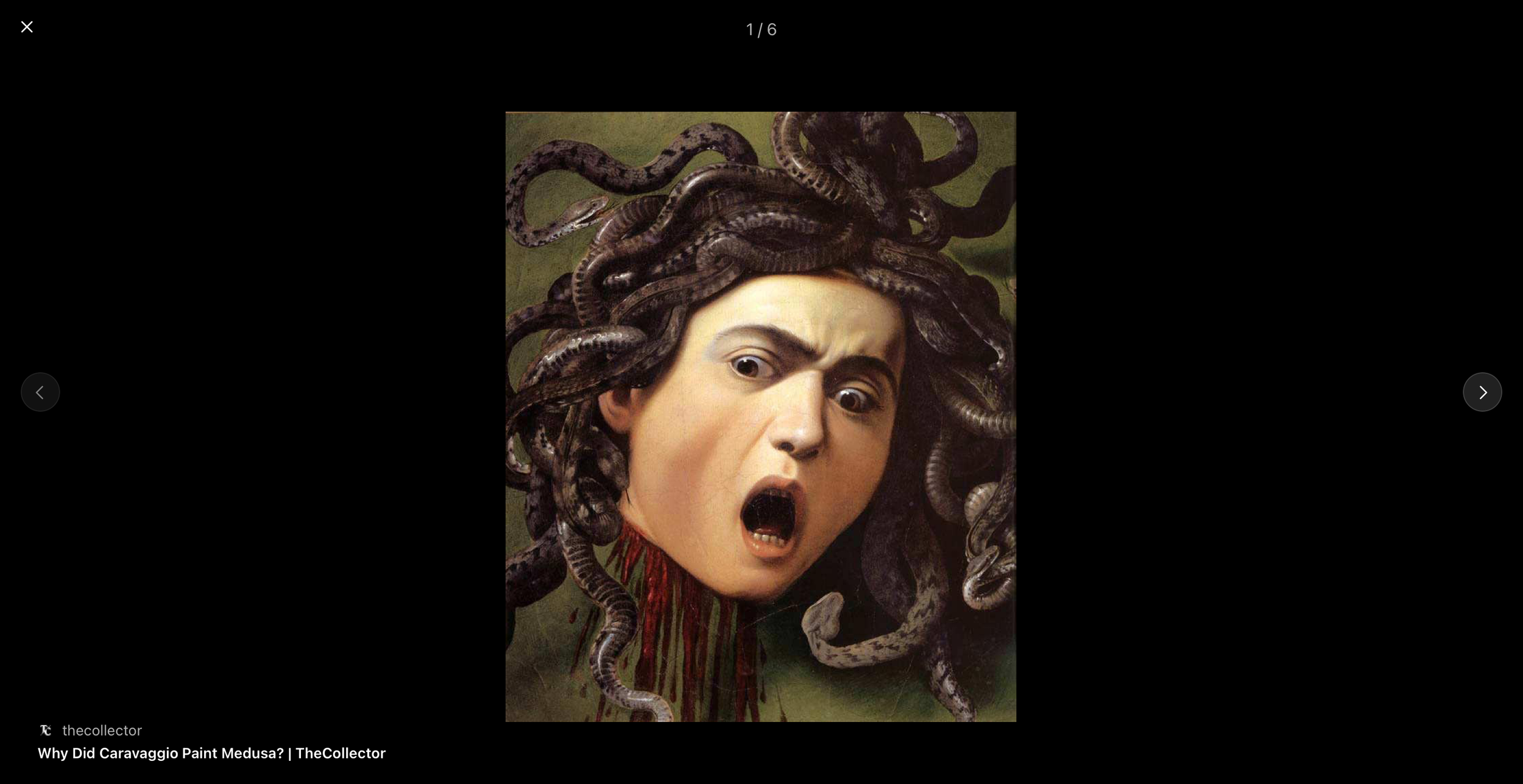
Caravaggio’s painting of Medusa’s severed head with snakes for hair, wide eyes, and a shocked expression, capturing fear, transformation, and the power of the mythological feminine.
Some images refuse to disappear.
Among the countless figures that have traveled across centuries through paintings, sculpture, literature, and cinema, few continue to captivate the imagination as powerfully as Medusa. She appears terrifying and mesmerizing at once—her hair transformed into serpents, her gaze capable of turning anyone who meets it into stone.
Artists have painted her for over two thousand years. Poets have rewritten her story. Psychologists have interpreted her as an archetype. Feminists have reclaimed her as a symbol of survival. Each generation seems compelled to look into her eyes and ask the same question:
Who is Medusa, really?
Perhaps the enduring fascination with Medusa says less about her than it does about us.
Every culture creates stories to explain what it fears, what it desires, and what it struggles to understand. Mythology is never merely entertainment; it is a psychological language through which civilizations project their collective anxieties and ideals.
Medusa is one of those projections.
In the earliest Greek traditions, she is born a Gorgon—a monstrous being whose gaze turns others to stone. Later, in Ovid's Metamorphoses, she becomes a beautiful woman transformed after experiencing sexual violence. These versions do not simply tell different stories; they invite different psychological questions.
Rather than asking which version is "correct," I find myself wondering why certain versions continue to resonate more deeply than others.
Stories evolve because cultures evolve.
They also reveal what a society chooses to remember—and what it chooses to forget.
For centuries, Western art largely portrayed Medusa through the eyes of those who confronted her. She became the obstacle the hero must overcome, the frightening feminine, the embodiment of danger.
The narrative centered the hero.
Rarely did it pause to imagine the interior life of the woman.
This is not unique to Medusa.
Throughout history, women in mythology have often been distilled into archetypes: the virgin, the mother, the temptress, the witch, the muse, the monster. Such archetypes simplify complexity, making human experience easier to categorize than to understand.
Psychology invites us to do something different.
Rather than asking whether Medusa is good or evil, psychology asks what she represents within the human psyche.
Perhaps Medusa is the face of trauma.
Perhaps she is the image of rage after violation.
Perhaps she embodies the parts of ourselves that become difficult to recognize after profound suffering.
Trauma transforms identity.
It alters perception, relationships, memory, and even the body itself. Survivors often describe feeling as though they have become strangers to themselves, while others respond to them with discomfort, confusion, or fear.
The myth gives this transformation a visual language.
The snakes.
The gaze.
The isolation.
The impossibility of being seen without terrifying others.
Whether literal or symbolic, these images communicate something words often cannot.
As a psychologist, I am struck by another aspect of the story.
People become stone not because Medusa touches them, but because they look at her.
Perhaps petrification is less about magic than about what happens when we encounter realities too painful to integrate.
Psychologically, human beings often freeze in the presence of overwhelming emotion. We become immobilized by grief, shame, fear, or horror. Entire societies can become emotionally "petrified" when confronted with collective trauma or injustice they do not yet know how to face.
The image of stone may be mythology's way of illustrating a psychological truth.
Art has always understood this.
Artists return to Medusa because she gives form to experiences that remain largely invisible. She becomes a canvas upon which every generation projects its own questions about femininity, beauty, power, vulnerability, and fear.
Even the famous image of Perseus approaching her with a mirrored shield invites reflection.
He cannot face her directly.
He must encounter her through reflection.
That detail feels profoundly psychological.
Healing rarely begins through confrontation alone.
It begins through reflection.
Through symbols.
Through dreams.
Through images.
Through the slow work of seeing what once felt impossible to bear.
Perhaps this explains why Medusa continues to appear in contemporary art, literature, and psychotherapy. She is no longer simply a monster from antiquity. She has become an archetypal image through which we contemplate transformation itself.
The artist sees composition.
The historian sees culture.
The feminist sees structures of power.
The psychologist sees the human soul attempting to speak through symbol.
None of these perspectives cancels the others.
Together, they remind us that myths are living organisms. They change because we change.
Maybe the purpose of myth is not to provide definitive answers but to create images spacious enough for every generation to rediscover itself.
When I look at Medusa now, I no longer see only a monster.
I see a mirror.
One that asks not, Who was she?
But rather,
What does the way we tell her story reveal about us?